

Table of Contents
- What Separates High Quality Graphic Tees for Men From the Rest
- Fabric Durability Testing: How to Check a Tee Before You Buy
- How to Style Graphic Tees for Men Without Looking Like a Walking Billboard
- How to Wash Graphic Tees to Prevent Fading (Without Babying Them)
- Best Graphic Tee Brands for Men: What to Look For in 2026
- Graphic Design Trends Forecast: What's Coming for Men's Tees in 2026
- Frequently Asked Questions
Last Updated: September 13, 2026
What Separates High Quality Graphic Tees for Men From the Rest
Most graphic tees are disposable: a dozen wears, a cracked print, a warped collar, then garage-rag status. High quality graphic tees for men come down to three things you can check in thirty seconds: fabric weight, cotton type, and print method. This guide breaks down all three.
Fabric weight is measured in ounces per square yard (oz/yd²). Lightweight tees run 4.0 to 4.5 oz, midweight 5.0 to 5.5 oz, and heavyweight 6.0 oz and up (Standards). Heavier fabric drapes better, hides the print edge, and holds shape through repeated washing.
Cotton type matters as much as weight. Ring-spun cotton uses tightly twisted, smoother fibers that feel softer and print cleaner than open-end cotton. A poly-blend (50/50 or 60/40) adds moisture-wicking and reduces shrinkage.
Print method decides how long the design lasts. Screen printing sits on top of the fabric and holds up best for bold, simple graphics. Direct-to-garment (DTG) handles detailed, hand-drawn and photo-realistic artwork but can fade faster on dark colors. Neither is universally better; it depends on the design.
Fabric Weight, Cotton Type, and Print Method
The practical shortcut: flip the shirt inside out. A screen print feels slightly raised and rubbery; a DTG print sits flatter and softer. If the print feels cracked or sticky when new, it won't survive twenty washes.
Look for pre-shrunk or garment-dyed labels. Pre-shrunk cotton minimizes shrinkage; garment-dyed tees are washed after sewing for a vintage look and softer hand. Both cost more and last longer.
Fabric Durability Testing: How to Check a Tee Before You Buy
You can test a tee's durability before you commit. These three checks take under a minute and save you from a shirt that looks great on the hanger and terrible after two washes.
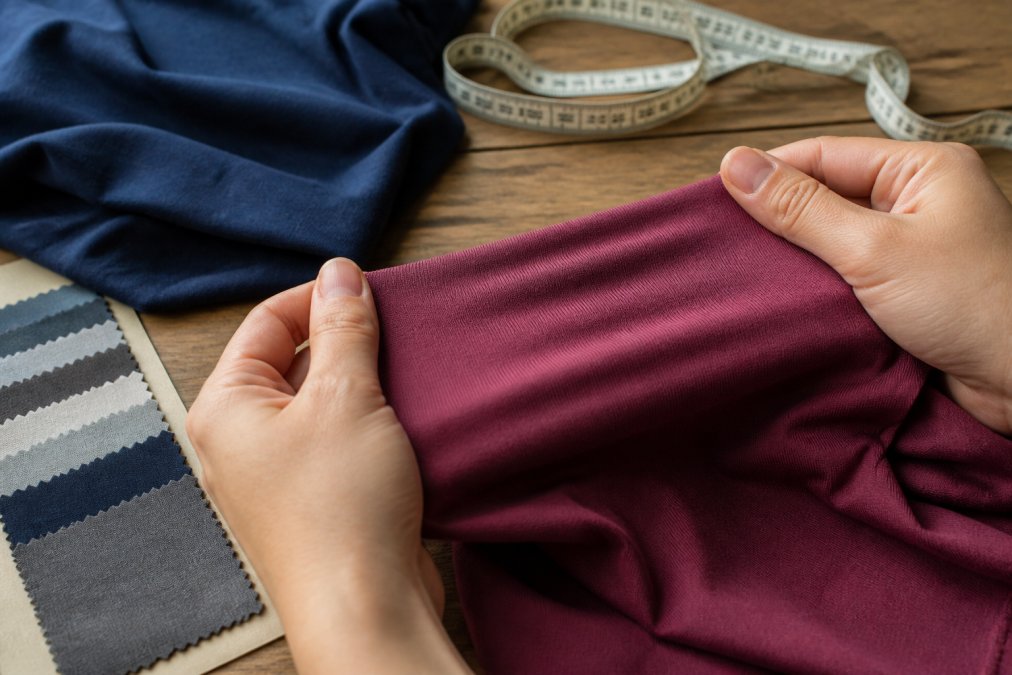
The Stretch Test, the Wash Test, and the Print Peel Test
The stretch test: Pull the fabric firmly on both sides of the chest. Quality ring-spun cotton snaps back without a ghost mark. If it stays deformed, the knit is loose and will bag at the elbows and waist.
The wash test: "Dry clean only" is a red flag for a graphic tee. A durable tee should survive a cold machine wash and low tumble dry without pilling or fading.
The print peel test: Pick gently at the print's edge with a fingernail. A well-cured screen print won't lift; a poorly cured DTG print peels like dried glue. It's the fastest way to spot a shirt that'll look ragged in a month.
How to Style Graphic Tees for Men Without Looking Like a Walking Billboard
Styling graphic tees is about balancing loud with quiet: the shirt is the statement, everything else supports it. A fitted crew-neck with a bold print works with dark denim and clean sneakers; an oversized tee with a subtle graphic pairs with tapered joggers or chinos and an overshirt.
The biggest mistake is competing graphics. If your shirt has a large, busy design, skip the patterned pants and the logo-heavy jacket. Let one piece do the talking.
Body-Type Specific Styling: Fitted, Oversized, and Everything Between
Most styling guides stop at "slim vs. relaxed." Fit actually changes based on shoulder-to-waist ratio, torso length, and where you carry weight. Here's how to translate a graphic tee into a silhouette for your build.
Athletic or V-taper build (shoulders wider than waist): A fitted crew-neck with a slightly tapered waist flatters without clinging. Look for a chest measurement 2 to 3 inches larger than your actual chest so fabric drapes instead of stretching across the lats. Avoid boxy cuts and ultra-slim cuts that pull at the armpit seams.
Slim build (shoulders and waist close in width): A relaxed or oversized fit adds visual bulk. Aim for a shoulder seam 0.5 to 1 inch past your natural shoulder line and a body length hitting mid-fly. Heavyweight fabric (6.0 oz and up) holds structure instead of collapsing.
Husky or stocky build (waist wider than or equal to shoulders): A straight-hem, relaxed-fit tee with a slightly longer body balances proportions. Choose heavyweight fabric that drapes rather than clings, avoid tapered waists that bunch at the midsection, and use a small chest print or left-chest logo to draw the eye up.
Broad shoulders with a shorter torso: Drop-tail hems and longer body lengths (28 to 30 inches from high point of shoulder) prevent riding up when you reach or sit, more important than chest fit here.
Taller frames (6'2" and up): Standard body lengths (27 to 28 inches) ride up. Look for extended lengths and drop-tail hems, with sleeves hitting mid-bicep.
Shorter frames (under 5'7"): A classic fit hitting mid-hip keeps proportions clean. Oversized can work if the shoulder seam stays close to your actual shoulder line. Skip full-chest-width prints; a centered graphic 8 to 10 inches wide reads better.
For pet owners, a slightly longer tee that covers your back when you bend to pick up a leash or scoop a litter box is worth prioritizing, a 1 to 2 inch drop-tail hem makes a real difference.
The 3-Color Rule and Other Quick Frameworks
A styling shortcut that works across every build: keep the outfit to three colors maximum and let the graphic supply one. Neutral base (black, white, gray, navy, olive), one supporting tone (denim, khaki, brown), and the graphic's dominant color.
Other quick rules that hold up:
- Print size scales with build. A 12-inch-wide print on a 5'6" frame reads as a billboard; on a 6'3" frame it reads as a chest graphic. Match print width to roughly 40 to 50 percent of your shoulder width.
- Tuck or don't, but commit. A front-tuck works with higher-rise pants and shows the belt. A full tuck needs a shorter body length or it billows. An untucked tee should end between mid-fly and the bottom of your fly.
- Layer to break up a loud print. An open overshirt, denim jacket, or zip hoodie cuts the visible print area roughly in half and makes a bold graphic wearable in more settings.
- Match formality, not color. A faded vintage-wash tee with raw denim and beat-up sneakers reads casual. A crisp heavyweight tee with chinos and clean leather sneakers reads smart-casual. The graphic doesn't change the formality; the fabric finish and outfit do.
How to Wash Graphic Tees to Prevent Fading (Without Babying Them)
Turn the shirt inside out, wash cold, tumble dry low. Fading and cracking come from heat and abrasion, not washing itself.
A few habits that make a real difference:
- Wash graphic tees in cold water (under 30°C / 86°F) to protect dye and print adhesive.
- Skip the dryer on high heat; low or air-dry preserves colorfastness.
- Avoid fabric softener, which leaves a residue that breaks down print adhesion over time.
- Don't iron directly over the print; if you must iron, do it inside out on low.
For pet-hair-covered tees, lint-roll before washing rather than overloading the machine, hair trapped in the drum abrades prints faster than normal wear.
Best Graphic Tee Brands for Men: What to Look For in 2026
The best graphic tee brands for men share a few traits: transparent fabric specs, domestic or ethically verified production, and a guarantee covering sizing and print defects.
At Snarky Tails, our tees are made in the USA with eco-friendly, plant-based, and recycled fabrics, and every order includes a 30-day guarantee plus free size exchanges. For pet lovers who want a shirt that survives cuddles, dog park trips, and stable chores, that matters more than a flashy tag logo.
The 5-Question Brand Scorecard
Instead of ranking brands, use a scorecard. Any brand that answers all five questions clearly is worth your money; any brand that dodges two or more is not.
- What's the fabric weight, in ounces per square yard? If the spec sheet doesn't list it, that's a red flag. Midweight (5.0 to 5.5 oz) is the sweet spot for year-round wear; heavyweight (6.0 oz and up) is better for structure and print longevity.
- What's the cotton type and blend ratio? Ring-spun cotton prints cleaner and feels softer than open-end. A 60/40 or 50/50 cotton-poly blend reduces shrinkage and adds moisture-wicking, but poly blends shed microplastics.
- What print method is used, and is it disclosed? Screen print holds up best for bold, simple graphics. DTG handles detailed artwork but can fade faster on dark colors. Brands that name their method are usually proud of it.
- Where is it made, and is that verifiable? Domestic production shortens the supply chain and makes labor conditions easier to audit. Overseas production isn't automatically worse, but the brand should be able to name the factory or certification (WRAP, Fair Trade, or similar).
- What's the guarantee, and does it cover print defects? A 30-day return window is standard. A guarantee that specifically covers print cracking or fading is rare and worth paying for.
Print Longevity: How to Test a Brand Before You Commit
Most brands talk about softness; almost none talk about how long the print lasts. Here's how to test print quality without buying ten shirts.
Buy one, wash it five times, and inspect. A well-cured screen print survives five cold washes with no visible cracking; a low-cure print crazes at the edges by wash three. It's the single most useful test you can run.
Check the print edge on arrival. Run your fingernail along the edge of the design. If it lifts, the ink wasn't fully cured. If it feels rubbery and thick, it's a heavy deposit that will crack faster than a thin, well-cured print.
Look for a print warranty.
Check the wash tag for cure temperature clues. Some brands list curing specs. A screen print cured correctly (typically 320°F for plastisol) outlasts the shirt's stitching; a DTG print cured too fast fails in a month (Print on Synthetics).
Environmental Impact Analysis: Screen Print vs. DTG
If you care about your tee's footprint, the printing method matters as much as the fabric.
Screen printing uses plastisol or water-based inks. Plastisol is PVC-based and not biodegradable; water-based inks are more eco-friendly but harder to cure and less common. Screen printing also needs a separate screen per color, so setup waste scales with design complexity: efficient for a one-color design on a 100-shirt run, wasteful for 12 colors on 10 shirts.
DTG printing uses water-based inks and no screens, so there's no per-color setup waste, more efficient for small runs and complex designs. The trade-off: DTG can require more pre-treatment chemistry, and dark-color prints often need a white underbase that adds weight and can crack.
The fabric side matters more than the print side. Conventional cotton uses significant water and pesticides. Organic cotton reduces both. Recycled cotton diverts textile waste from landfills. Environmental Protection Agency textile waste data tracks how much textile waste ends up in landfills each year, and printed tees are a meaningful slice of that.
The practical takeaway: For the lowest-footprint tee, look for organic or recycled cotton, water-based inks, and domestic production. For the longest-lasting print, look for a well-cured screen print on heavyweight ring-spun cotton. Those goals don't always align, knowing which you're optimizing for is the whole game.
When comparing brands, ask the five scorecard questions, run the five-wash test on one shirt, and decide which trade-off you're willing to make.
Graphic Design Trends Forecast: What's Coming for Men's Tees in 2026
Design trends for 2026 lean two directions at once: maximalist retro and minimalist hand-drawn. Retro is back with vintage-wash tees, faded palettes, and 70s and 90s typography, while single-line hand-drawn artwork and small chest-print graphics gain ground for guys who want a subtle statement rather than a billboard.
Pop-culture and licensed apparel still dominates shelf space, but real growth is in niche, community-driven designs: pet-parent humor, hobby-specific graphics, and inside-joke tees for cat people, dog people, and horse owners. The humor has to land, though, designs that try too hard read as cringey and get returned.
Looking further out, expect more garment-dyed heavyweight tees, more size-inclusive cuts, and more brands publishing fabric specs like nutrition labels. Transparency is becoming a selling point, not a nice-to-have.
If you're shopping for a graphic tee in 2026, buy fewer, better shirts. Check the fabric weight, check the print method, wash them cold, and pick designs that actually make you laugh. That's how you build a wardrobe staple instead of a drawer full of regret.
Frequently Asked Questions
How can you tell if a graphic tee is high quality?
Check three things: fabric weight (heavyweight cotton holds shape longer), stitch density at the seams, and print method. Screen-printed graphics on ring-spun cotton outlast cheap direct-to-garment prints on thin poly-blend fabric. Look for pre-shrunk labels, reinforced collar stitching, and a soft hand feel that doesn't pill after one wash. If the shirt feels paper-thin or the print looks cracked before you buy it, walk away.
What are the best graphic tee brands for men in 2026?
The best graphic tee brands for men prioritize fabric specs over flashy marketing. Look for brands that disclose cotton type (ring-spun vs. standard), fabric weight (5.5 oz and up for durability), and print method. Domestic production, ethical sourcing, and clear return policies signal a brand that stands behind its product. Snarky Tails, for example, offers 100% made-in-the-USA tees with eco-friendly fabrics and a 30-day guarantee.
How do I wash graphic tees to prevent fading?
Turn the tee inside out, wash in cold water on a gentle cycle, and skip the dryer. Heat breaks down screen-printed ink and causes cracking. Hang dry or tumble on low. Use a mild detergent without bleach or fabric softener, which coat the fibers and dull colors. For direct-to-garment prints, avoid ironing directly on the graphic. Following these steps keeps prints colorfast for years, not months.
Do high quality graphic tees for men justify a higher price?
High quality graphic tees for men use heavier cotton, better stitching, and print methods that survive repeated washing. Domestic production and ethical labor also add cost. Check the brand's return policy and fabric specs before deciding.
Finding a graphic tee that survives real life with pets, kids, and a hundred washes is harder than it should be. Snarky Tails makes it simple: ridiculously soft, durable tees printed with humor that actually lands, backed by a 30-day guarantee and free size exchanges. Every shirt is made in the USA with eco-friendly, plant-based, and recycled fabrics, and every order ships with tracking. Get started with Snarky Tails and wear your pet obsession on your sleeve.